

Arthur Mensch’s landmark hearing before the National Assembly laid out a stark vision and a harder question: does Europe have the will to act on it?
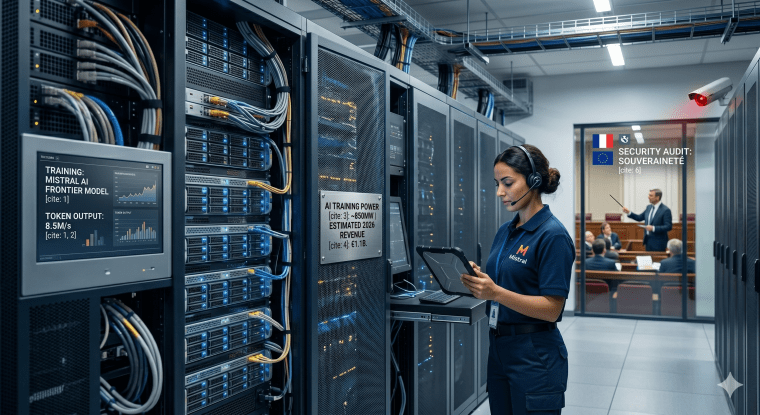
Context: On May 12, 2026, Arthur Mensch (co-founder and CEO of Mistral AI, France’s leading AI company) was summoned before the French National Assembly’s inquiry commission on structural dependencies and systemic vulnerabilities in the digital sector. He appeared alongside Audrey Herblin-Stoop, Mistral’s head of public affairs. The session, which ran for over ninety minutes, was broadcast live on LCP (La Chaîne Parlementaire). What follows is a detailed account and analysis of his testimony.
When France’s most prominent AI entrepreneur sat down before elected representatives last week, he didn’t come with soothing reassurances. Arthur Mensch offered lawmakers something rarer: a coherent industrial thesis about where Europe stands in the global AI race, what it stands to lose, and what it would take to remain a player. At the center of his argument was a deceptively simple idea: artificial intelligence is not software. It is a technology that transforms electricity into tokens. And Europe, he warned, is at risk of exporting its electrons and importing its intelligence.
AI Is Not a Software Product, It Is an Energy Transformation Technology
The most striking conceptual move Mensch made in his opening remarks was definitional. He asked lawmakers to stop thinking of artificial intelligence the way they think of a smartphone app or a cloud service subscription, and start thinking of it the way they think of a steel mill or an aluminium smelter.
The logic goes like this: to generate one response from a large language model (one “token” of machine intelligence) you need electricity. A great deal of it. Data centers consume power for computation, for cooling, for the infrastructure that keeps the servers running twenty-four hours a day. AI, in this framing, is fundamentally an industrial-scale energy-conversion process. Electrons go in. Tokens come out.
“AI is an energy-transformation technology. You feed electrons in one end, tokens come out the other.” Arthur Mensch, CEO of Mistral AI, French National Assembly, May 12, 2026
This reframing is more than rhetorical cleverness. It has a direct strategic implication for France specifically: the country runs on nuclear energy. Its electricity is among the most decarbonized and, at scale, among the most cost-competitive in Europe. France, by this logic, holds a genuine geographic and industrial advantage in the AI race, an advantage that most public discourse has entirely overlooked.
But Mensch’s point cuts both ways. If France has this advantage, it is already being contested. American cloud operators (Microsoft, Amazon, Google) are actively signing long-term contracts with EDF and other European utilities to secure electricity supply for their own data center expansions on European soil. The electrons France produces are being converted into tokens but increasingly, those tokens are generated by American systems, serving American AI products, accruing value to American companies.
The question Mensch posed before the Assembly, and that members struggled to fully engage with, is this: if France does not deliberately orient its electricity surplus toward its own AI players, it is, in effect, exporting raw energy and importing finished intelligence. It would be, he suggested, structurally analogous to an oil-producing country that exports crude and buys back refined petrol. Except here, the “refined product” is not fuel. It is cognitive infrastructure, the layer that will increasingly mediate how citizens, companies, and governments access knowledge, make decisions, and do work.
Key Data Points from the Hearing
France’s electricity surplus: Approximately 9 GW of surplus nuclear electricity capacity already being targeted by American cloud operators through long-term contracts with European utilities.
Mistral’s AI cost: AI consumption at Mistral already represents roughly 10% of total payroll, a figure Mensch used as the basis for his larger European projections.
Mistral’s scale: Valued at approximately €12 billion, employing around 1,000 people, targeting €1 billion in revenue by end of 2026. Revenue is 70% non-French, positioning it as a European exporting champion.
Model pricing: Around €1 per million tokens on entry-level models, with industry gross margins around 50%, funding training cycles that cost hundreds of millions per frontier model generation.
The “Trillion Euros” Argument: A Memorable Number With Real Stakes
The figure that dominated press coverage was this: if AI adoption reaches even a fraction of Mensch’s projections, Europe faces a trade deficit of roughly one trillion euros per year, simply from importing AI services from abroad.
The arithmetic runs as follows. At Mistral, spending on AI for internal operations already amounts to about 10% of the company’s total payroll. Extrapolated across the European economy over the next three to four years, as AI becomes as routine a business expense as cloud storage or telecoms and 10% of European payroll represents approximately €1 trillion annually. If that sum flows exclusively to foreign providers, primarily American hyperscalers, it lands directly on Europe’s trade deficit.
The image worked. It dominated post-hearing coverage and was probably designed to. But it is worth examining carefully, because the figure is illustrative rather than forensic. Extrapolating the AI spending ratio of a company whose core business is producing AI to the whole European economy is methodologically aggressive. A professional services firm, a city hall, or a manufacturing SME will not adopt AI at the same intensity as Mistral. The figure also assumes that all value created by AI is exported as payment, ignoring the productivity gains, the new products, and the locally captured margins that AI will also generate.
None of this makes the underlying concern less real. The structural asymmetry between Europe and the United States in digital services has been well documented for over a decade. Europe imports far more digital services from the US than it exports, and that gap has widened with each technology cycle, from social platforms, to cloud computing, to mobile ecosystems. Mensch’s argument is that AI represents not just the next chapter in this story, but a qualitatively different one, because AI, unlike a social network or a cloud storage bucket, will become foundational infrastructure for every other sector of the economy.
“In a world where you import all of your digital services from the United States, you have no leverage over the United States.” Arthur Mensch, May 12, 2026
Sovereignty Is Not Protectionism, It Is Leverage
The most intellectually substantive part of Mensch’s testimony was his reframing of digital sovereignty. The concept has often been wielded awkwardly in European policy debates, oscillating between industrial nationalism on one side and naive optimism about regulatory power on the other. Mensch offered a more precise and more useful formulation.
Sovereignty, he argued, is not about closing borders or building a digital fortress. It is about maintaining the capacity to negotiate from a position of credibility. A continent that imports 100% of its AI from one country has nothing to put on the table in any negotiation with that country. It cannot credibly threaten to shift suppliers. It cannot impose meaningful standards. It cannot protect its citizens’ data, its defense institutions’ secrets, or its cultural output from the logic of a foreign model trained on foreign assumptions.
To have leverage, Europe needs at least one credible alternative at every critical layer of the AI stack: training infrastructure, base models, application frameworks, and cloud hosting. It does not need to win the AI race. It needs to remain a player and enough of one that its absence would matter to those it negotiates with.
This argument connects to a subtler point Mensch raised about cultural and linguistic sovereignty. When a European government, business, or citizen uses an AI model, they are using a system trained predominantly on Anglo-American content, which encodes Anglo-American linguistic patterns, cultural assumptions, legal frameworks, and political intuitions. The model doesn’t just process queries; it structures how questions are framed, what counts as a good answer, and which perspectives feel natural. The French national benchmark for LLM performance (developed by Giskard in partnership with Google DeepMind) has documented measurably worse performance from major models when operating in French compared to English. Linguistic asymmetry is not a soft cultural concern. It is a quantifiable structural bias.
The Sovereign AI Stack, what Mensch Argued Europe Must Build
Energy infrastructure: Orient France’s decarbonized electricity surplus toward domestic and European AI training rather than letting it be locked up by American hyperscalers through long-term utility contracts.
Base models: Maintain at least one competitive European frontier model capable of matching American systems on performance, so that European institutions have a credible alternative to rely on.
Public procurement: Use the leverage of European public spending (representing roughly 50% of GDP) to build demand for European AI and cloud suppliers, creating the economic foundation that allows domestic players to scale.
Defense and critical sectors: Ensure that sensitive operations (including military cybersecurity, critical infrastructure, and state institutions) never depend on foreign AI systems that can unilaterally restrict or revoke access.
Jobs, Productivity, and the Displacement Problem Nobody Wants to Name
Perhaps the most politically charged moment of the hearing came when Mensch addressed employment. He did not soften the message.
AI, he told lawmakers, is already eliminating entire categories of work within Mistral itself. Engineers at the company, he said, “no longer write lines of code.” AI systems do that work. The speed of this transformation, he argued, means that entire professions are being restructured faster than educational systems, labour markets, or social safety nets can adapt.
When pressed on whether this could mean higher unemployment, Mensch was direct: he does not exclude it. In certain sectors, he acknowledged, you will see job displacement. The economic effect he identified is the same one economists have long theorized about but rarely seen at this scale in the real world: a structural shift in the distribution of value from labour to capital. When AI replaces a human task, the economic surplus that task generated doesn’t disappear, it flows to whoever owns the AI. And right now, the capital that owns the most powerful AI systems is overwhelmingly not European.
This is where the electricity-to-tokens metaphor becomes most pointed. If European workers are displaced by AI, and the AI doing the displacing is owned by American companies, then the productivity gains of this technological revolution flow largely out of Europe. European workers lose income. European governments lose tax revenue from labour. And the surplus flows to a small number of shareholders in California and Seattle.
Mensch stopped short of prescribing solutions to the labour displacement question that, he indicated, is properly the domain of elected representatives, not AI entrepreneurs. But the implicit message to the Assembly was clear: the choices made now about AI sovereignty are not abstract geopolitical positioning. They determine whether the prosperity generated by this technological revolution is shared within Europe or extracted from it.
Electricity, Scarcity, and the Hidden Inflationary Risk
One of the less-covered but genuinely important warnings Mensch delivered concerned the intersection of AI and energy markets. The rapid expansion of AI infrastructure requires enormous amounts of electricity. Data centers (particularly those running the most computationally intensive training and inference workloads) are among the most power-hungry facilities ever built. And this demand is growing exponentially.
The world, Mensch told lawmakers, does not currently have enough electricity. Grid capacity is constrained in most advanced economies. The transition away from fossil fuels is proceeding, but slowly. Meanwhile, AI’s appetite for power is accelerating. This creates what he described as “conflicts of use”, situations where electricity must be rationed between industrial, residential, and AI-related demands. And when you have scarcity competing with surging demand, the result is inflation.
For France, this creates a specific policy dilemma. The country’s nuclear capacity is a genuine strategic asset and one that makes French AI development cheaper and more sustainable than it would be almost anywhere else. But that same electricity is needed for industry, for heating, for electric vehicles, for all the other demands of a decarbonizing economy. Allocating it to AI data centers is a choice with real trade-offs.
What Mensch’s testimony made clear, even if it didn’t resolve the dilemma, is that this allocation is currently happening anyway through market mechanisms, through long-term contracts signed between American cloud operators and European utilities, without any public debate and without any deliberate strategic direction from national governments. The question for policymakers is not whether France’s electricity will be used for AI. The question is whether France’s electricity will be used for French AI.
The AI Act: Genuine Concern or Convenient Complaint?
Mensch did not hold back when addressing European AI regulation, and particularly the EU AI Act, which France ratified in early 2024. His critique was frontal: the cumulative weight of European regulation (GDPR, copyright legislation, national data protection rules, and the AI Act) creates a compliance burden that disproportionately disadvantages smaller European companies relative to the American giants who can absorb compliance costs as a rounding error on their balance sheets.
The argument has genuine merit. A 500,000-euro compliance cost represents a manageable legal expense for OpenAI or Google. For a European scale-up with a couple of hundred staff, it can represent months of runway, the kind of friction that delays product launches, redirects engineering resources, and creates openings for better-capitalized competitors to capture market share.
Mensch also raised a concern about the patchwork of 27 different national regulatory interpretations of European law. Even when the law is harmonized at the European level on paper, implementation varies enormously across member states hence creating a fragmented internal market that makes it difficult to build a pan-European product at speed. An American company operates with a single legal framework across a single market of 335 million people. A European company, in practice, often operates across 27 different legal environments.
But the critique deserves some scrutiny. Mistral lobbied actively against key provisions of the AI Act and particularly the thresholds that trigger “systemic risk model” classification, which would impose transparency and audit obligations on the most powerful models. Some of those obligations relate to training data transparency, a commercially inconvenient requirement for any company that has trained on content without explicit licensing. The right debate is not deregulation versus regulation. It is proportionality: which obligations, at what thresholds, with what enforcement mechanisms. Mensch is right that fragmentation destroys European scale. He is less clearly right that every individual obligation is a brake on innovation.
Defense, Cybersecurity, and the Limits of Foreign AI
The sharpest and most concrete passage of the hearing concerned national security. Mensch referenced a situation that had recently come to light: Mythos, a cybersecurity AI tool developed by Anthropic with significant capabilities for identifying vulnerabilities in software, has access restrictions that exclude certain European institutions, including, reportedly, bodies connected to French defense and intelligence.
“We cannot let Mythos scan the source code of the French armed forces,” Mensch told the Assembly. “That creates an irreparable dependency, and we need to find a solution.”
The point is harder to argue with than most of his others. A defense or intelligence agency that depends on a foreign AI system for critical security functions is exposed to a risk that cannot be hedged: the foreign provider can unilaterally restrict, modify, or revoke access. The provider may be subject to the laws of its home country in ways that conflict with the interests of the contracting state. And the data processed by that system (potentially including sensitive source code, communications, or operational details) flows through infrastructure the host country does not control.
This is not a hypothetical. The pace at which AI is proving useful for offensive and defensive cybersecurity is accelerating. Security researchers have documented that frontier AI systems can identify software vulnerabilities substantially faster than traditional methods which means the window between the discovery of a vulnerability and its exploitation is narrowing. Relying on foreign AI to defend domestic systems against foreign threats, in this environment, is a structural vulnerability that Mensch argued European policymakers cannot afford to ignore.
Public Procurement: The Lever That Nobody Pulls
Perhaps the most actionable recommendation Mensch made, and the one that received the least attention in press coverage, was about public procurement. European public spending represents roughly 50% of GDP. A meaningful share of that spending currently flows to American technology companies: cloud infrastructure, software licenses, AI services, managed platforms. If even a portion of that procurement was systematically oriented toward European alternatives on markets defined as critical, the internal demand base that European AI companies currently lack would begin to form.
This is, in fact, how the United States built its technology ecosystem. Not primarily through declared preferences for American products, but through technical specification requirements (security clearances, data sovereignty standards, audit requirements, certifications) that de facto excluded foreign providers from sensitive public contracts. The result, accumulated over decades through DARPA funding, NASA contracts, Pentagon procurement, and NIH grants, is a domestic technology industry with a guaranteed foundation of public demand that allowed it to scale, compete, and eventually dominate global markets.
Europe has this lever available. The legal framework, particularly for contracts touching national security, already permits member states to apply preference criteria. The obstacle is not primarily legal. It is political will and technical specificity. Governments would need to define demanding, verifiable requirements around data sovereignty, audit rights, and hosting location and then actually enforce them. That work sits entirely within the hands of national administrations, without changing a word of European law. And it is barely being done.
Mistral’s April 2026 white paper, “European AI: A Playbook to Own It” laid out 22 specific recommendations along these lines with European preference clauses in public procurement for AI and cloud services at the center. Whether governments will act on them, or whether the recommendations will serve primarily to advance Mistral’s commercial interests, is a question the Assembly might have pressed harder on.
What the Hearing Left Unsaid
Any testimony before a parliamentary commission is, among other things, a performance. Mensch is a skilled communicator, and his hearing was strategically constructed. It is worth noting what he chose not to discuss.
Open-Weight Models as Public Infrastructure
Mistral built its early reputation on open-weight models, AI systems whose underlying parameters are publicly released, allowing anyone to run, fine-tune, and build on them without paying licensing fees. This approach, championed by Mistral (and by Meta with its LLaMA series), represents a genuinely different model of AI sovereignty: one built on public infrastructure rather than national champions. A world with strong open-weight models is a world in which European developers, researchers, and companies can access frontier AI capabilities without depending on any single commercial provider being American or French. Mensch chose not to foreground this dimension, preferring to speak about Mistral as an institution rather than about the open ecosystem it helped create.
Environmental Costs of the Frontier Race
France’s decarbonized electricity is presented as a clean asset, and in relative terms it is. But the ten-year energy trajectory of a world where multiple countries and dozens of companies are training hundred-billion-parameter models every eighteen months is not neutral. The environmental footprint of frontier AI is substantial and growing. Framing electricity allocation for AI as simply a smart strategic move skips a public conversation that deserves to happen about how much of this infrastructure Europe actually wants, and what it is willing to trade for it.
European Linguistic Plurality
European sovereignty cannot mean swapping American linguistic hegemony for French-speaking hegemony. Europe’s 24 official languages, and the dozens of regional and minority languages beyond them, each represent distinct cultural traditions and epistemic frameworks. A truly sovereign European AI ecosystem would need to be genuinely multilingual and not just French-centric. This is a harder and more expensive problem than building a competitive French LLM, and it received no attention in the hearing.
The Human Cost of Transition
Mensch acknowledged, with notable candor, that AI is likely to cause unemployment in specific sectors and to shift value from labour to capital. But having named it, he moved on. The social and political management of this transition (retraining programs, unemployment support, redistribution mechanisms, democratic deliberation about which uses of AI are acceptable and which are not) is at least as important as the question of which company builds the model. Parliament, in this hearing, had an opportunity to push harder on what European AI sovereignty is ultimately for. What kind of economy and society does it serve? That question remained largely unasked.
Conclusion: The Window Is Open, but Narrow
Arthur Mensch’s hearing before the French National Assembly was, by parliamentary standards, unusually substantive. He placed before elected representatives a set of questions that the European political class has been slow to engage with at the necessary level of technical and strategic seriousness: AI as industrial infrastructure, electricity as strategic raw material, digital dependency as a structural vulnerability with economic, cultural, and military dimensions.
The central image he left (electricity converted into tokens) is both memorable and precise. It captures something that much AI commentary misses: this technology has weight. It has physical externalities. It requires land, water, energy, and capital at industrial scale. And like all heavy industries, the nations that build it capture its value; the nations that merely consume it import its costs.
Europe has a window. French nuclear capacity provides a genuine competitive advantage. A generation of world-class AI researchers with many of them, like Mensch himself, trained in France’s grandes écoles, chose to build in Paris rather than migrate to San Francisco. A regulatory environment that is, for all its friction, pushing toward standards on data sovereignty and transparency that could become genuinely valuable assets in a world of increasing AI distrust.
Whether that window stays open depends on choices that are now, genuinely, in the hands of the people Arthur Mensch was speaking to: lawmakers, policymakers, and the governments they hold accountable. He told them what the stakes are. What they do with that information is a political question, not a technical one.