

A deep dive into the AI strategy buried inside SpaceX’s S-1 filing: data centers, frontier models, space-based compute, chip factories, and an agentic platform designed to run software companies without humans
When most people think about SpaceX going public, they think rockets. Reusable boosters. Starship. Starlink. The Mars mission. The usual Musk megaproject vocabulary.
What they are not thinking about is that SpaceX’s S-1 filing describes a company that has quietly assembled one of the most vertically integrated AI stacks on the planet. The filing doesn’t bury this. It’s right there in the structure: SpaceX now operates three business segments. Space. Connectivity. And AI.
That third segment deserves a lot more attention than it is getting.
First: How Did SpaceX Become an AI Company?
The short answer is two acquisitions in rapid succession.
In March 2025, xAI (Elon Musk’s AI company) acquired X Holdings, the parent of the social platform formerly known as Twitter. Then in February 2026, SpaceX acquired xAI outright. Because these transactions happened between entities under common control, the S-1 consolidates all of it retroactively: SpaceX’s financials now include xAI, Grok, and X going back through history.
The result is a company that, on paper, simultaneously operates the world’s leading orbital launch business, the world’s largest satellite internet constellation, a frontier AI lab, a major social media platform with 550 million monthly active users, and a gigawatt-scale AI data center. All under one roof.
That is not a diversified tech company. That is a specific theory about what it takes to win in AI, executed through a series of aggressive bets. Understanding what those bets are is the point of this post.
The Financial Scale of This Bet Is Not Small
Before getting to the strategy, the numbers deserve a pause.
In 2025, SpaceX’s AI segment generated $3.2 billion in revenue, primarily from advertising, subscriptions, and data licensing on X. At the same time, the AI segment consumed $12.7 billion in capital expenditure and $5.1 billion in R&D (up from $1.2 billion the year before). SpaceX also raised $16 billion in debt specifically to fund AI operations.
In Q1 2026, the AI segment brought in $818 million in revenue and posted an operating loss of $2.47 billion.
To put it plainly: SpaceX is spending roughly five dollars on AI for every one dollar AI earns back. This is not a profitable business today. It is an investment thesis executed at industrial scale, funded partly by the profitability of Starlink and backed by an unusually long time horizon.
Lose money long enough and fast enough in the right direction, and sometimes you end up owning a market. That appears to be the plan.
COLOSSUS: The Gigawatt AI Factory
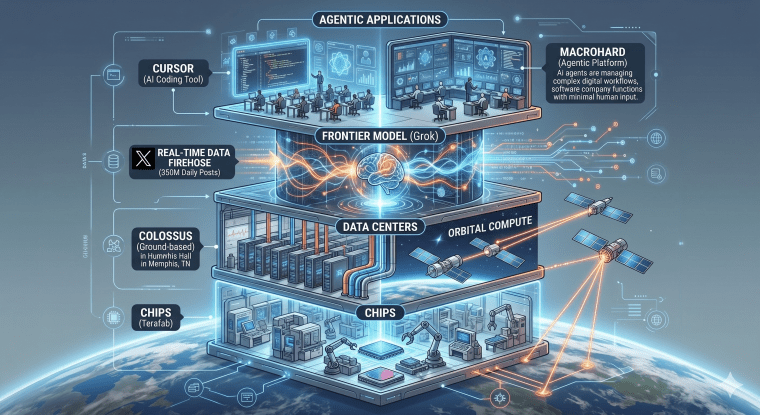
The most concrete piece of the AI infrastructure story is COLOSSUS, SpaceX’s flagship AI training cluster located in Memphis, Tennessee, with an extension called COLOSSUS II spanning Memphis and Southaven, Mississippi.
The filing describes it as a “coherent gigawatt-scale AI training cluster.” One gigawatt. For context, a typical large data center consumes somewhere between 100 and 500 megawatts. COLOSSUS is designed to operate at ten times the lower end of that range.
This facility is not just where Grok gets trained. It is the foundation of SpaceX’s AI compute business, which sells access to external customers as well. The filing makes clear that data center capacity is a product in its own right, not just an internal resource. COLOSSUS is simultaneously R&D infrastructure, competitive moat, and revenue generator.
The constraint on scaling it further? Power and chips. The filing is candid that both are limiting factors, and that solving them is a central preoccupation of the business going forward.
Grok: A Frontier Model With a Structural Data Advantage
Grok is SpaceX’s family of frontier AI models. The filing describes it as “truth-seeking artificial intelligence,” designed for “rigorous reasoning and real-time information synthesis.”
Most AI companies train their models on large static datasets. Grok has something different: permanent, exclusive access to X’s firehose of real-time human conversation. With approximately 350 million daily posts on X, Grok is continuously updated with current information in a way that models trained on periodic snapshots simply are not.
This is not a small advantage. Real-time grounding is one of the most consistently cited limitations of large language models. Grok is structurally built around solving it.
The business model around Grok is also more layered than a simple subscription service. The filing describes Grok API access for developers, Grok Business for small and medium teams, Grok Enterprise for large organizations, and an advertising strategy where Grok actively helps brands optimize campaigns and align with trending content on X. The social platform and the AI model are not separate products. They are designed to reinforce each other.
At 550 million monthly active users combined across Grok and X, the distribution is already there. Converting those users to paid subscribers and AI-enabled services is the next monetization challenge the filing explicitly names.
The Physical Stack Thesis
Here is where the SpaceX strategy diverges most sharply from what other AI companies are doing.
The filing contains one line that, in my view, is the most important sentence in the entire document: “the future of AI will be determined by the control of the physical stack.”
Not the best model. Not the most users. The physical stack. Chips. Data centers. Power. Infrastructure. SpaceX is betting that the companies that control the hardware layer will ultimately control AI outcomes, and it is building accordingly.
This explains two initiatives that might otherwise look disconnected.
Terafab is a chip manufacturing initiative developed jointly with Tesla and Intel, targeting the production of 1 terawatt per year of compute hardware. The goal is to reduce dependence on third-party chip suppliers (primarily Nvidia), optimize chip design for SpaceX’s specific workloads including space-hardened processors, and bring manufacturing costs down over time. The filing draws an explicit parallel to Starship: SpaceX manufactures roughly 80% of Starship in-house. The same logic is being applied to AI silicon.
Orbital AI Compute is the initiative that no other company on earth could plausibly announce. SpaceX intends to begin deploying AI compute satellites into orbit as early as 2028. These are not communication satellites. They are data centers in space: powered by solar energy, cooled by the vacuum of space, connected to ground infrastructure via Starlink. The economics are genuinely interesting. Solar power in orbit is abundant and constant. Radiative cooling requires no water, no fans, no chillers. And the launch cost per kilogram, which has dropped by over 90% thanks to SpaceX’s own reusable rockets, makes this a viable option rather than a science fiction premise.
The connection between the Space and AI segments is not coincidental. It is the whole point. SpaceX’s ability to put mass into orbit cheaply is what makes orbital AI compute possible. The rocket company and the AI company are the same bet.
Macrohard and Cursor: The Application Layer
If COLOSSUS is the factory and Grok is the model, the application layer is where things get genuinely strange.
Macrohard is an agentic AI platform being developed jointly with Tesla. The filing describes it as designed to “fully emulate digital workflows and augment human operation of computers,” with the stated ambition of enabling “a fully AI-operated software company.” The vision, as written, is that Macrohard would allow organizations to run software operations with dramatically fewer humans involved.
This is extremely early stage. The filing is careful to note that both Macrohard and Terafab “are in the very early stages.” But the fact that a publicly filed S-1 names this as a strategic initiative is significant. Companies do not put things in S-1 filings for fun. Every word is reviewed by lawyers. Macrohard is a declared intention.
Cursor, the AI coding tool that has become one of the most popular developer products of the past year, is also in the picture. SpaceX has an option to acquire Cursor at a predetermined price. The filing flags this as a strategic extension: controlling the coding tool that millions of developers use, integrating it with Grok’s models and COLOSSUS compute, and embedding it into the broader SpaceX AI ecosystem.
Together, Macrohard and a potential Cursor acquisition represent the application layer sitting on top of the infrastructure. The stack goes: chips (Terafab) at the bottom, data centers (COLOSSUS and orbital compute) in the middle, frontier model (Grok) above that, and agentic applications (Macrohard, Cursor) at the top.
What This Actually Adds Up To
Taken individually, each of these initiatives is interesting. Taken together, they describe something with no real precedent in the technology industry.
The argument SpaceX is making, implicitly, is this: AI competition will eventually become a competition for physical resources, not just algorithmic cleverness. The companies that can train faster, infer cheaper, and deploy at global scale will win. To do that, you need chips you control, data centers you own, orbital infrastructure nobody else can build, training data nobody else has, and a distribution platform already used by hundreds of millions of people.
SpaceX either has or is actively building every single one of those things.
The risk is just as clear as the opportunity. The AI segment is losing billions per quarter. Terafab and orbital compute are unproven at scale. Macrohard is a declared ambition without a shipping product. The Cursor acquisition may or may not close. And the whole thesis assumes that controlling the physical stack is actually the winning strategy, which is far from guaranteed in an industry where a “small open-source model” from a Chinese lab (DeepSeek) recently matched the performance of models requiring hundred-million-dollar training runs.
But that is what makes this worth watching. SpaceX is not hedging. It is making a very specific, very large, very expensive bet on how AI will evolve over the next decade. The S-1 is essentially a public declaration of that bet, spelled out in enough detail that anyone willing to read it carefully can see exactly what the plan is.
Most people are reading the rocket stuff.
Conclusion: The Vertical Integration Playbook, Applied to AI
SpaceX’s core competitive advantage has always been vertical integration. Where other aerospace companies outsource, SpaceX builds in-house. Where others buy components, SpaceX designs them. That philosophy has made it the most efficient launch provider in history.
The same playbook is now being applied to AI, at a scale that only SpaceX could attempt. Owning the chips, the data centers, the orbital infrastructure, the model, the data source, and the application layer is not a diversification strategy. It is an attempt to make the entire AI supply chain a proprietary system.
Whether it works is an open question. That it is being attempted, openly, in a public filing, with real numbers attached to it, is a fact that deserves far more attention than it is receiving.
Sources: Space Exploration Technologies Corp. S-1 Registration Statement, 2026.